Eligible cat
Practical meaning
The animal insured by this offer
Document to check
Declarations and enrollment conditions

Follow the cat, event and invoice through three separate branches of health-insurance review.
Use these checkpoints to frame the literal question before reading the full guide.
For cat health insurance, first ask whether the actual cat is eligible, then whether the event qualifies, and finally which costs enter reimbursement. Stop when a branch lacks evidence. A cat accepted for enrollment is not thereby guaranteed payment for every illness, and an eligible expense need not be reimbursed in full.
The sections below show how to verify the answer and what can change it.
Use the cat’s documented age or honest estimate, residence and available veterinary history. For a newly adopted cat, list records that have not been obtained rather than describing the history as clear. Check enrollment restrictions in the actual offer. If the cat already has insurance, begin with its renewal documents before considering replacement.
Stop here if eligibility has not been confirmed. Do not use a quotation screen with guessed age or address as evidence. A saved offer for another cat in the household cannot answer this cat’s eligibility question.
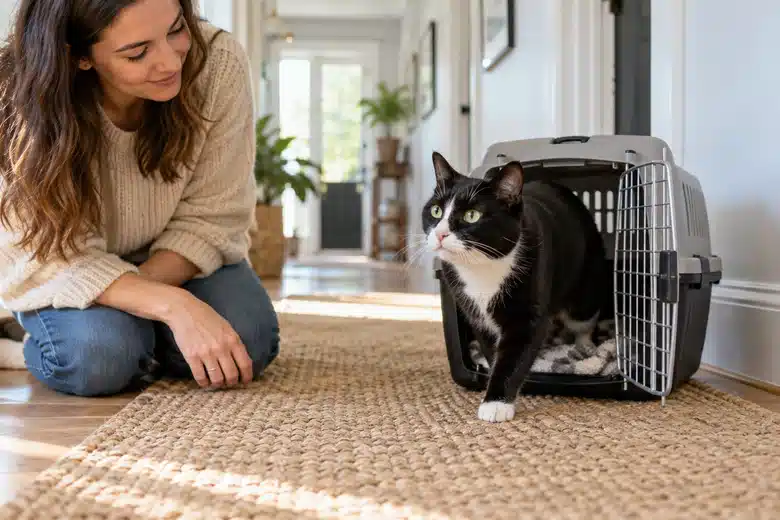
Name the event in expense terms: a consultation, diagnostic work, treatment or a routine service. Put first relevant signs beside the policy start and timing provisions. If care is needed now, arrange it with the veterinarian while the insurance question is unresolved. Insurance research is not a reason to delay a cat’s care.
| Policy term | Practical meaning | Document to check |
|---|---|---|
| Eligible cat | The animal insured by this offer | Declarations and enrollment conditions |
| Eligible event | A qualifying accident or illness | Coverage grant and exclusions |
| Routine benefit | Whether planned services have a separate allowance | Wellness schedule |
| Retained cost | The part of an eligible bill left to you | Formula, deductible and limits |
| Required claim file | Evidence needed for assessment | Claim instructions and medical records |
Keep policy terms, deductible, reimbursement and limits beside the quote so the comparison stays consistent.
Use this wholly hypothetical cat bill: $800 total, including $100 that the invented plan does not cover. Assume it subtracts a $200 remaining deductible from the $700 eligible amount, then reimburses 80%. The result is $400; the owner retains $400 of the bill, plus the premium. No annual ceiling is reached. These numbers teach the sequence and are not a quote, typical cat-treatment price or product recommendation.
If the same invented inputs instead apply 80% before subtracting $200, payment becomes $360. That $40 difference comes from the assumed order, not a change in the cat’s medical care. Read the actual formula and use the remaining deductible. Do not choose an order because it produces the more appealing number.
Maryland’s consumer guide describes the common pattern of paying the veterinarian and then seeking reimbursement. The actual clinic arrangement and policy still need checking. Keep the immediate amount due separate from the amount you hope to recover.
For a fictional owner with only $250 available at the clinic, neither $400 nor $360 of later reimbursement resolves an $800 payment due immediately. That is a cash-flow issue as well as a coverage issue. Ask the clinic about its actual payment requirements and maintain a reserve for excluded care; do not count an unapproved claim as cash in hand.
No individual cat’s eligibility or claim has been evaluated. The method helps locate a missing answer and avoids turning a sample calculation into a coverage promise.
Lifestyle alone does not establish enrollment or claim eligibility. Read the actual offer and contract.
No. Premiums, excluded lines, your percentage, limits and upfront clinic payment may also matter.
These links provide independent government, academic or reference background. Actual policy wording controls insurance eligibility, benefits and claims.
Keep the policy terms beside the price, then continue to rates when the comparison is clear.